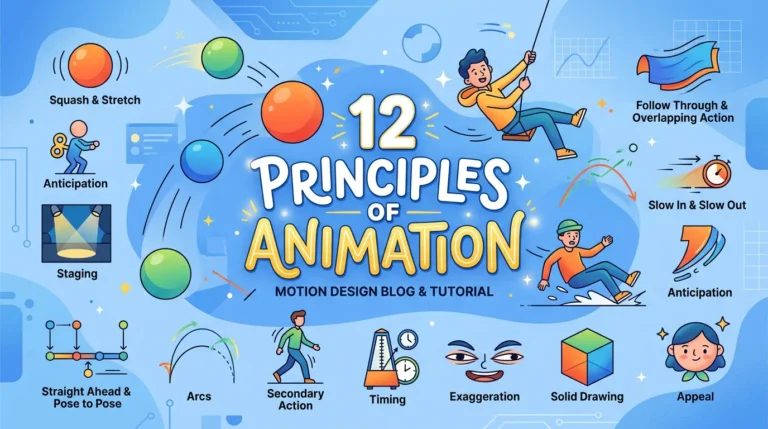
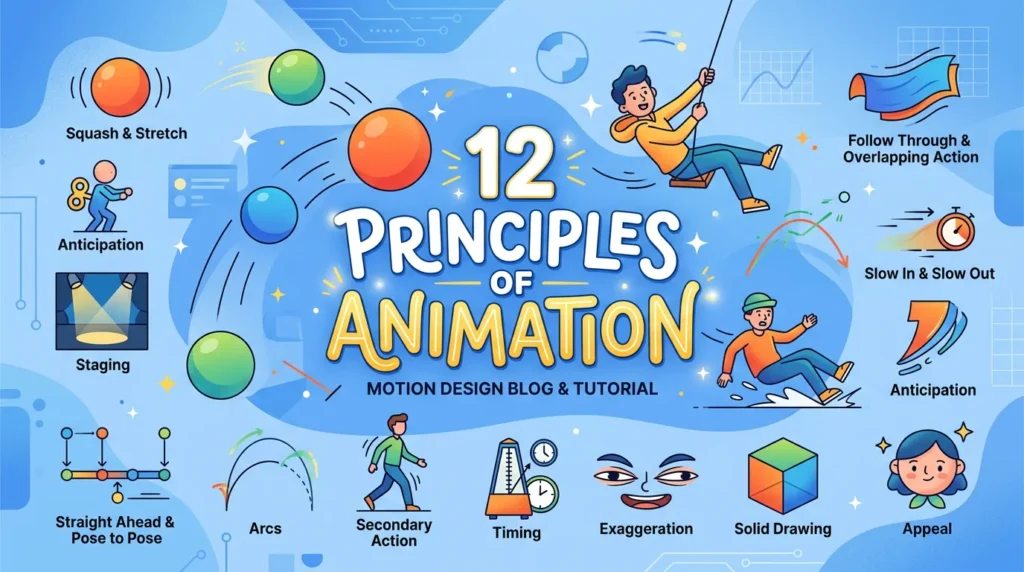
Animation is the art of transporting the viewer into fantastic worlds. At its core lie the 12 principles of animation, developed by legendary Disney animators Frank Thomas and Ollie Johnston in their book The Illusion of Life (1981). These are fundamental rules that allow animators to give characters and objects weight, dynamics, and personality in their movement.
Here are those 12 principles along with explanations for each:
1. Squash and Stretch

Flexibility and Elasticity
This principle emphasizes the need to give volume and weight to objects and characters by deforming them during movement. This adds a sense of realism and exaggeration to the animation.
2. Anticipation

Preparation for Action
Before a character makes a significant movement or action, there should be a brief moment where they prepare for it. This helps the audience understand what is about to happen and adds depth to the animation.
3. Staging

Presentation and Clarity
Staging involves arranging elements in a scene to clearly convey the story. Proper framing, camera angles, and composition direct the viewer’s focus to the most important elements.
4. Straight Ahead Action and Pose to Pose

Two Approaches to Animation
These are two distinct animation techniques. The straight ahead method involves creating each frame sequentially, whereas the pose-to-pose method focuses on setting key poses first and then filling in the intervals. Both methods have their applications depending on the desired effect.
5. Follow Through and Overlapping Action

Secondary Motion
Objects and characters should continue to move slightly even after their primary action stops (follow through), and different parts of a character may move at different rates or in different directions (overlapping action). This adds realistic fluid motion.
6. Slow In and Slow Out

Smooth Start and Stop
To make movements look more natural, objects should start and end their actions gradually, accelerating and decelerating. This principle prevents harsh, robotic movements.
7. Arcs

Natural Trajectories of Action
Most natural movements follow curved, arc-like paths rather than straight lines. Animators must ensure characters and objects move along arcs to mimic real-world physics.
8. Secondary Action

Supporting Actions
Secondary actions complement the primary action and add depth to a character or scene. These can include facial expressions, gestures, or any other movement that enhances the animation.
9. Timing

Pace and Rhythm
Timing is crucial for creating the mood and rhythm of an animation. It determines how fast or slow actions occur and can evoke different emotions in viewers.
10. Exaggeration

Emphasizing Reality
Exaggeration is used to heighten characters’ actions and emotions, making them more expressive and engaging. However, it should be used in moderation to maintain believability.
11. Solid Drawing

Three-Dimensional Forms
Animators must understand traditional drawing principles, including anatomy, perspective, and form, to create characters and objects that appear three-dimensional and volumetric in a 2D space.
12. Appeal

Attractiveness and Personality
Appeal refers to the charisma and likability of characters. It lies in designing characters with unique and interesting traits that capture the audience’s attention and empathy.
Mastering Animation: The 12 Fundamental Principles Explained
These principles serve as the foundation for animators in crafting compelling stories and characters. Although developed for traditional hand-drawn animation, they remain fully relevant in modern digital animation techniques.
Beginners and seasoned professionals alike rely on these principles to captivate viewers and breathe life into their creations, reminding us that the magic of animation lies in its ability to make the impossible feel real.